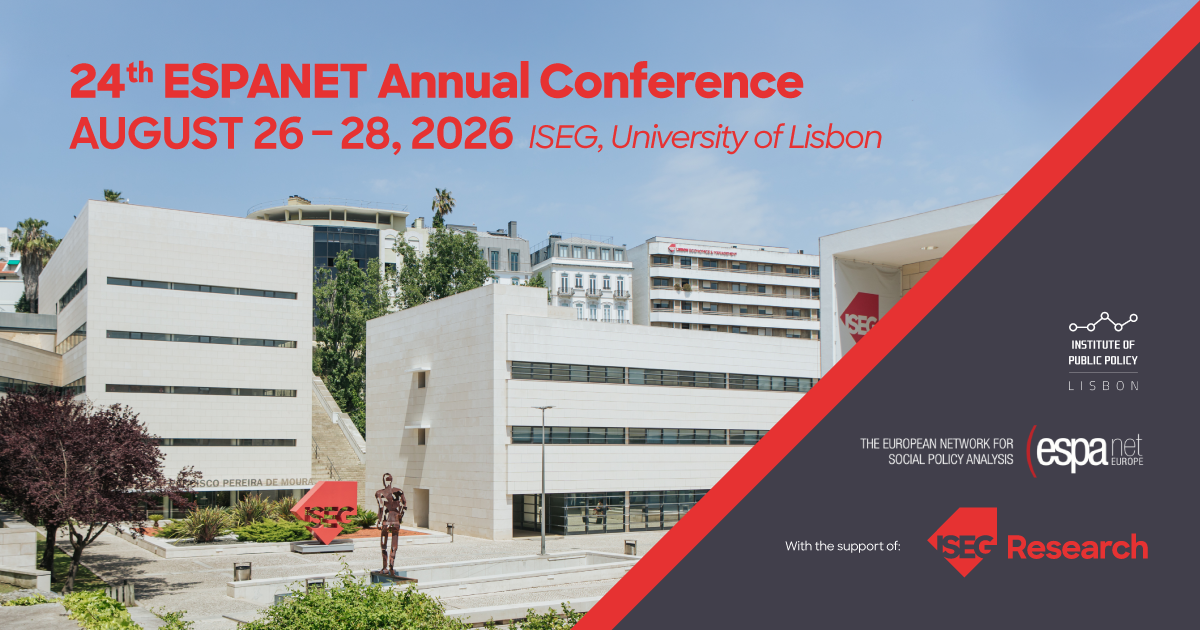
ESPAnet 2026 will be held in Lisbon, August 26-28, at the Lisbon School of Economics & Management (ISEG), University of LIsbon. The conference is organised by the Institute of Public Policy – Lisbon (IPP) (link: https://www.ipp-jcs.org/en/home-page_en/), with the support of ISEG Research in Economics and Management (ISEG Research) (Link: https://www.iseg.ulisboa.pt/en/investigation/).
The European Social Model faces growing pressure from global economic tensions, rising military threats, climate change, technological transformation, and AI. At the same time, the rise of radical right-wing and populist movements is reshaping welfare politics, influencing both support for social protection and policy priorities. The 2026 ESPAnet Conference in Lisbon will examine how these changes are redefining the welfare state in Europe, including its purpose, scope and methods of delivering social protection.
With this in mind, we warmly invite colleagues to submit paper proposals that could fit one of the Streams listed below:
- Welfare States, Demography and Bodies
- Time-Related Social Policies in the World of Work and Care
- Providing Social Security for Older People: Interactions of Different Social Policies, their Drivers and Outcomes
- Disability, Citizenship, and the Future of the Welfare State in Europe
- The Politics of Education
- The Matthew Effect in Social and Educational Policies and the Intergenerational Transmission of Disadvantages Over the Life Course
- Employment Policies and the Quest for a European Labour Market
- Families in Transition: Rethinking Social Policy Design
- The Role of the European Union in Caregiving and Parenting: What Direction are Family Policies Taking?
- New Perspectives on Poverty and Economic Inequality
- Pensions in the 21st century: Challenges, Policy Feedback and Political Dynamics
- Social Policy Context of Life-Course Transitions
- De-Standardization of Retirement Pathways: Conceptual, Institutional, and Life-Course perspectives
- Welfare States and Migration: Welfare Attitudes and Welfare Access
- Transformative Social Policy in Times of Climate Change
- Sustainable Welfare and Eco-Social Policy
- Scarring Effects of the Pandemic: Inequality, Poverty, and Social Policy After COVID-19
- Food Insecurity and Food Assistance: The Need for Social Policy
- Reconfiguring Welfare in the Triple Transition: Comparative Perspectives from Europe and East Asia
- Southern European Welfare Model’ Revisited: 30 Years On
- The Future of Social Europe: Policies, Outcomes and Political Legitimacy
- The Political Economy of the Welfare State across Time and Space
- The Politics of Welfare State Reform
- Restructuring Welfare Under Pressure: Juridification, Fragmentation and “Wrong-Pocket” Dilemmas
- Territorial Inequalities and the Welfare State: The Spatial Politics of Service Delivery
- Data, AI and Digital Infrastructure. Reshaping the Moral Economy of Welfare States
- Who Deserves Support? Deservingness, Poverty, and Activation in Contemporary Welfare States
- Political Representation of the Poor in Social Policy
- Policy Engagement, Knowledge Exchange, and Impact: Strengthening Evidence-Based Social Policy Research
- Social Workers and Social Policy: Policy Takers or Policy Makers?
- Causal Inference in Social Policy Analysis
- The Future of Policy Analysis Using Artificial Intelligence
- Teaching Social Policy in Higher Education
- Open Stream
- ‘Pitch Your Book’ Sessions
A full description of the content of each of these streams is available here (24th ESPANET Annual Conference – ISEG).
ABSTRACT SUBMISSION
Abstract submissions are made in the Conference website (link to page), and must cover the following items:
- Title
- Stream
- Author details, per author:
- Author(s);
- Affiliation;
- E-Mail address
- Abstract, between 350 and 500 words, (ideally) covering:
- Research Gap/Research Problem;
- Aim of the Paper;
- Research Question;
- Methodological Approach Adopted
- (Expected) Main Findings.
- Type of Contribution (Topic)
- Empirical: Quantitative Study
- Empirical: Qualitative Study
- Empirical: Mixed Methods
- Theoretical Contribution
- Methodological Contribution
- Other
Please note that:
- Papers that fall beyond the scope of the Streams 1 to 33 can be sent to the Open Stream;
- Abstract submissions are made through the Ex Ordo platform (accessible through the Conference website (https://2026espanetconference.exordo.com/login), which requires authors to create an account;
- Abstracts are submitted to one Conference Stream only;
- Authors can submit multiple abstracts, to multiple streams. However, the selection process will be conducted in such a way as to maximize the possibility that as many colleagues participate in the conference as possible;
- Stream organizers are not allowed to present a paper in their own stream.
Selection Procedure:
- Paper proposals will be assessed and ranked by Stream Organisers. However, for logistic reasons, the final decision will be made in consensus with the local Organising Committee.
Key Dates:
| Milestone | Date |
| Deadline for Abstract Submission | May 17th, 2026 |
| Notification of Result | May 31st, 2026 |
| Registration Opens | June 1st, 2026 |
| Registration Closes | August 10th, 2026 |
| Final Program | August 15th, 2026 |
We look forward to receiving your submissions!
On behalf of the Organising Committee.